What tankless installation, repair, and flushing involve
What a tankless water heater install, repair, or flush typically involves, from gas line and venting to service valves and scale.
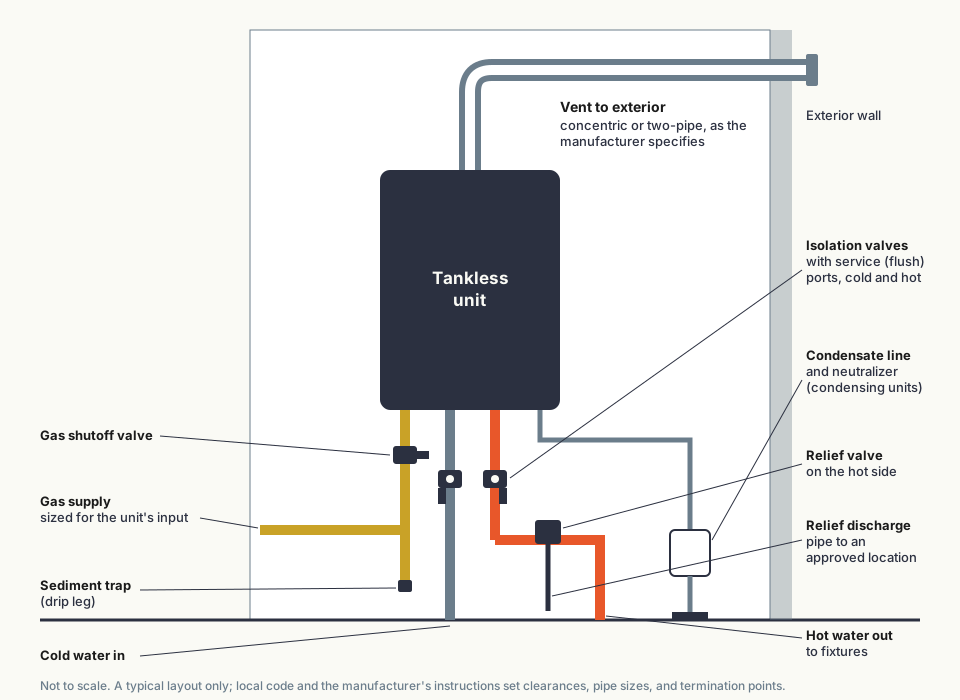
Replacing a tank with a tankless unit
Swapping a tank heater for a tankless one involves more plumbing than a tank-for-tank swap. The tankless unit moves to a wall, the gas line and vent often change, and the installer adds valves for flushing. Five things shape the quote.
- Peak demand. The installer counts the showers, tubs, and appliances that might run at once and adds up their flow in gallons per minute.
- Winter inlet temperature. The colder the incoming water, the less flow a given unit delivers. Ask how the contractor measured or estimated it.
- Gas supply. The U.S. Department of Energy's tankless guide says gas units may need a larger gas line, and that the line in the house will need to be 3/4 inch in most cases. The gas meter and the length of the run matter too.
- Vent route. Condensing units need a condensate drain.
- Water quality. Compare your city's published hardness with the manufacturer's water-quality limit, and decide on a softener or scale filter before install day.
Utah adopted the 2021 International Residential Code and the 2024 International Fuel Gas Code, effective July 1, 2026, under Utah Code 15A-2-103. Utah also amends some water heater sections statewide in Utah Code 15A-3-205. Several of those rules cover water heaters:
- Earthquake strapping. Utah's amendment says water heaters "shall be anchored or strapped to resist horizontal displacement caused by earthquake motion." The rule applies statewide.
- Relief valve and discharge pipe. The IRC requires a relief valve on appliances used to heat water. Utah adds that the discharge pipe must follow the manufacturer's instructions and not exceed 180 degrees in directional changes.
- Garage installs. In a garage, the IRC requires an ignition source to sit at least 18 inches above the floor unless the appliance is listed as flammable vapor ignition resistant.
- Drain pans. The IRC's pan rule (P2801.6) covers storage tank-type water heaters installed where leakage from the tank would cause damage. Utah adds that a water heater pan may receive discharge only from the water heater.
- Permit and inspection. Your city issues the permit and inspects the finished work. Provo asks for a gas line diagram with permits for tankless units. The permits guide lists each city's rules.
Provo's 2025 water report also recommends keeping household water pressure below 75 PSI. If your pressure runs higher, ask whether a pressure-reducing valve belongs in the job.
Typical install sequence
A typical gas conversion runs in this order. Your contractor may change it to suit the house.
- Pull the permit with the city.
- Shut off gas and water, then drain and remove the old tank.
- Mount the tankless unit on the wall and run or upsize the gas line.
- Install the vent and, on a condensing unit, the condensate drain.
- Connect cold and hot water through isolation valves with flush ports.
- Pipe the relief valve discharge, fire the unit, and check the gas pressure.
- Schedule the city inspection.
Repair and error codes
When something goes wrong, most tankless units display an error code. Each brand uses its own codes, so read the manual for your model. Rinnai's Value Series manual, for example, says the LC0 through LC9 codes mean scale build-up and that the heat exchanger needs flushing. If the scale warning comes back soon after a flush, ask whether the water needs softening to meet the manufacturer's hardness limit.
For no-heat or ignition problems, ask the contractor to check the gas supply and venting first. Before you call, write down the code, the model number from the label, and when the unit last got flushed.
Flushing
DOE's tankless guide says to flush according to the manufacturer's instructions, and puts the interval anywhere from twice a year to once every three years, depending on water quality and model. Rinnai's Value Series manual describes a flush with white vinegar. The manual also says lime build-up damage falls outside the unit's warranty, so keep a record of each flush.
A homeowner with the right valves can flush a unit with a small pump, two hoses, and a bucket. If the installer skips the isolation valves, each flush means cutting into the plumbing, so ask for them on the bid.
Questions to ask on a bid
- What flow rate did you size for, and at what inlet temperature?
- Does the bid include a new or larger gas line, and what size?
- Where does the vent exit, and where does the condensate drain go?
- Are isolation valves with flush ports included?
- Who pulls the permit and schedules the inspection?
- What does the manufacturer's warranty require for installation and maintenance? Get those terms in writing.
The contact page sends your request to an independent local contractor.
Common questions
How hard is the water, and why does it matter for a tankless unit?
Provo's 2025 water report says 10-15 grains per gallon, Orem's wells range from 7 to 25, and American Fork suggests setting softeners to 12.38. DOE notes that scale restricts flow through the heat exchanger and shortens unit life. Rinnai's Value Series manual lists a hardness limit of 200 mg/L, about 11.7 grains. Look up your own city's annual water quality report.
How often should a tankless unit be flushed?
Follow the manufacturer's instructions. DOE's tankless guide puts flushing anywhere from twice a year to once every three years, depending on water quality. Rinnai's manual describes a flush with white vinegar, and Rinnai's terms exclude damage from scale build-up.
Are there rebates for tankless water heaters?
Enbridge Gas Utah (formerly Dominion Energy) lists a $300 ThermWise rebate for an ENERGY STAR gas tankless water heater. The application is due within six months; check Enbridge's form for the exact rule. Rocky Mountain Power's Wattsmart water-heating incentives are for heat pump water heaters, not tankless units. Provo, Lehi, Spanish Fork, and Springville run their own electric utilities, so check your bill to see which one serves you.
Can I install a tankless water heater myself?
Utah exempts owners working on their own property from contractor licensing. But Utah Code 58-55-308 requires anyone who installs or replaces a residential gas appliance to first complete gas-appliance training and certification, and that applies even to people otherwise exempt. A permit and inspection still apply. Ask your city about its owner-builder form.
How do I check an installer's license?
Ask for their Utah license number and look it up on the state's licensee search at secure.utah.gov/llv. Utah's definition of the plumbing trade includes gas piping. Wasatch Tankless does not check or vouch for any contractor's license.
Who receives my request?
An independent local contractor. Wasatch Tankless publishes planning information and passes requests along. It does not install, repair, or service water heaters.
Send a request
Describe your home and current water heater. The request goes to an independent local contractor, who can talk through sizing, venting, and permits with you.